Fine Press Masterpieces
Collector’s editions for those who still recognise rarity
Literature Chosen for Long Return
Our editions are devoted to works that withstand time: poetry, prose and drama to which one returns at different moments in life, each time discovering a renewed depth of meaning. The selection of titles forms a thematic line rooted in the classics of world literature and chosen for their lasting intellectual and emotional force.
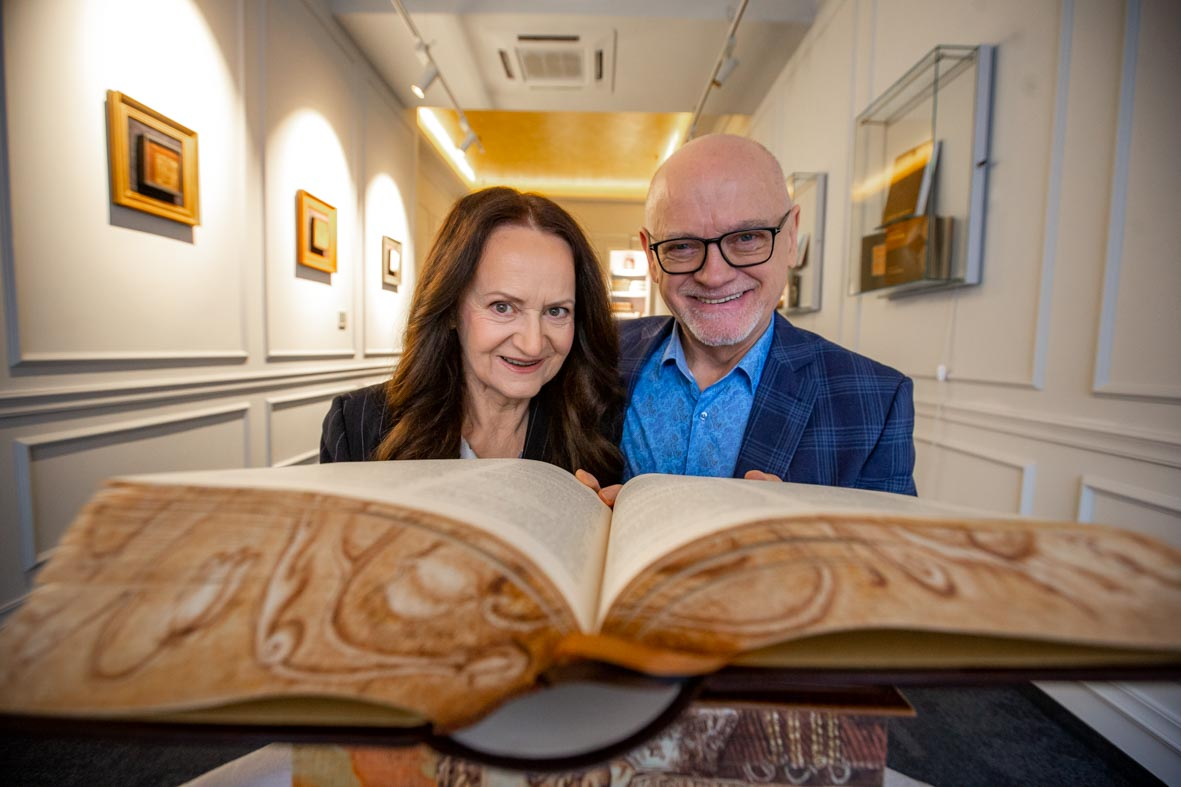
Since 1989, under our own imprint, we have published fine press and collector’s editions of selected works from the canon of world literature. Each edition is conceived as a complete literary and artistic statement in which text, image, paper, typography, and binding remain in deliberate dialogue. The book is not treated as a mere vessel of content, but as an interpretative object.
Our editions are printed on archival and permanent papers, illustrated with original works created specifically for each title, and bound by hand in noble materials. All are issued in strictly limited print runs, individually numbered, and formally documented.
What is presented here is necessarily selective. Many titles exist in multiple binding interpretations, and some editions contain unique or near-unique variants within the same bibliophile concept. A broader illustrated selection may be provided by private correspondence.
Books & Gardens
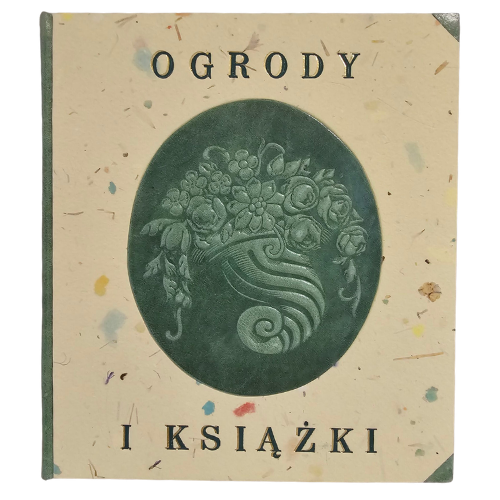
Books & Gardens is a personal album of Kurtiak & Ley Publishing House, situated within the world of a historic palace and its long-cultivated surroundings. It tells the story of restoration, gardening, and the shaping of landscape over twenty-five years.
Yet the book is about more than place. It reveals how the plant world enters artistic imagination and, more specifically, the decorative and symbolic language of bookbinding. Floral motifs recur not only in gardens, but in bindings, ornaments, and structural decisions taken across the publisher’s work. In this way, the edition becomes both documentary and self-reflective: a book about landscape, but also about the roots of visual form.
For the first time, augmented reality was incorporated as a bookbinding-related technique within this edition. The result is a book that extends beyond its surface without abandoning craftsmanship. It remains bibliophile in spirit even where it adopts contemporary means. Rather than using technology as spectacle, the edition uses it as an additional layer of interpretation.
Christmas Carol Songbook
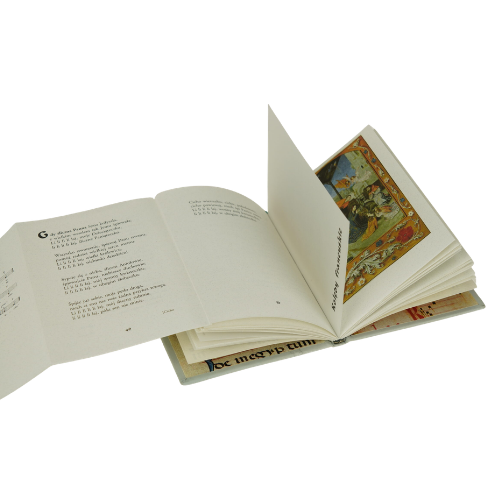
This collector’s edition was conceived as a book of intimate scale and exceptional refinement. Small in format yet technically ambitious, it was designed to preserve the ceremonial and musical character of Christmas carols while remaining elegant, portable, and deeply personal.
Its conception arose from an unusually precise request. The book was to be small, white, festive, suitable for Christmas, elegant enough for gifting, compact enough to fit into a woman’s handbag, and printed in three languages. These constraints did not diminish the project; they gave it its exacting character.
The trilingual structure required a rare solution. Because the English version of Silent Night is substantially shorter than the Polish and French texts, a special musical notation system was developed so that multiple language texts, printed on translucent paper, could successively align with the same score. The remaining carols were presented in independent language versions with their own musical notation.
The visual language drew on miniatures from medieval graduals. Most copies were bound in specially prepared white and cream silks, while selected copies were executed in leather, silver, and ornamental stones. The result is a collector’s book of modest dimensions but remarkable thought, restraint, and technical finesse.
Gräf Marion — Liebodrom
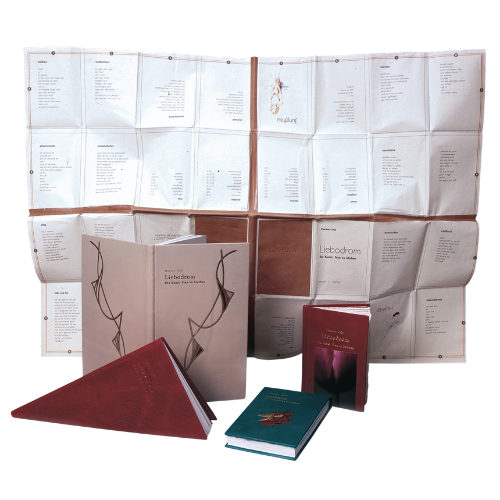
This debut volume by the German poet Marion Gräf was commissioned by the German press Mundtot and conceived as a collector’s project of exceptional formal variety. The poems are divided into four sections corresponding to successive stages in a woman’s life, and the edition answers that progression with an unprecedented diversity of physical forms.
Issued in seventeen different structures and shapes, the edition includes triangular books, tear-off notebook forms, and fold-out map-like constructions in which coordinates determine the location of poems. The bindings range from leather and silk to paper, collage, original photographs, and experimental contemporary structures.
This is not variation for novelty’s sake. Rather, Liebodrom becomes a study in how poetic sequence, biography, and material form may enter into dialogue. Each copy differs, yet all belong to one coherent literary conception. The edition is therefore both a book of poems and an investigation into what a book may become.
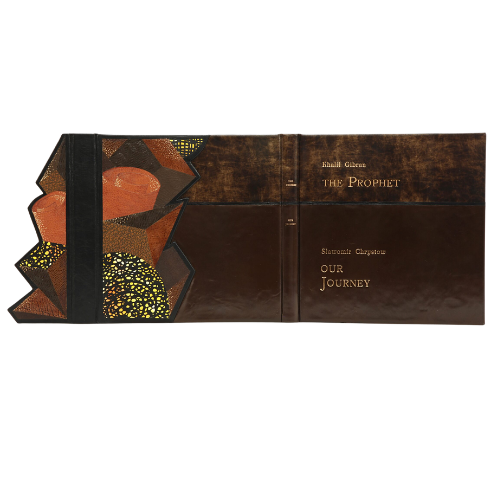
Gibran Kahlil — The Prophet
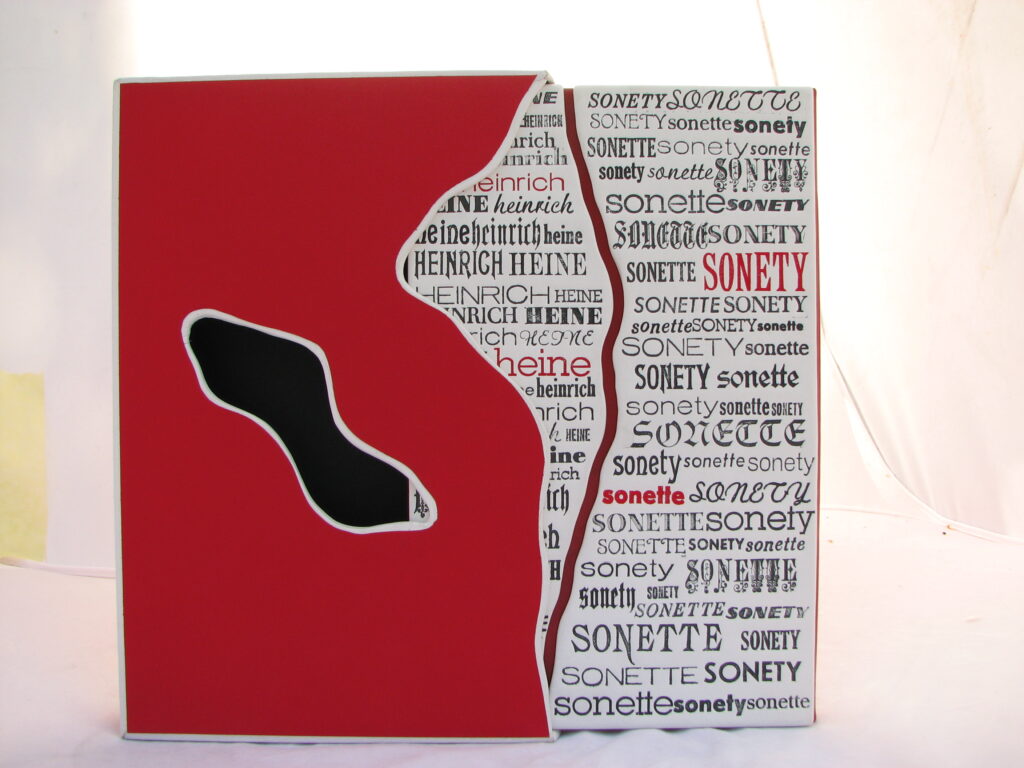
This first Polish–German bibliophile edition of Heine’s sonnets was conceived as a work of poetic atmosphere rather than mere bilingual presentation. For the first time, a series of sonnets from The Book of Songs appeared in Polish in this form, making the edition not only typographic and collector-oriented, but also translational and cultural in a deeper sense.
Printed with hand-set Nicolos Cochin type and issued on handmade paper, the book cultivates an aesthetic of quiet refinement. Browns, sepia tones, lead-grey inflections, and restrained leather bindings respond to Heine’s poetry as something intelligent, ironic, elusive, and resistant to easy transfer from one language into another. The first thirty-three copies are unique specimens, further intensifying the bibliophile character of the edition.
Danuta Imielska-Gebethner’s illustrations do not attempt to explain the poems. They move beside them, suggestive rather than literal, intuitive rather than descriptive. In this way, the volume preserves what matters most in Heine: not paraphrase, but atmosphere; not statement, but resonance.
Honey & Colocynth
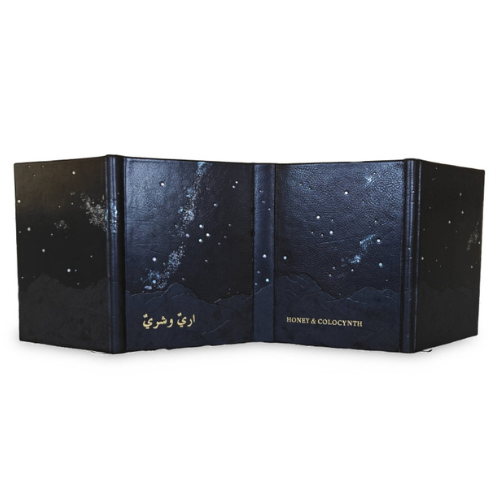
Honey & Colocynth is not organised around a single author, but around a poetic world. As an anthology of old Arabic poetry, it brings together a tradition in which tenderness and austerity, sensuality and discipline, sweetness and bitterness remain in powerful tension. That tension stands at the centre of the edition’s conception.
Presented as a bilingual English–Arabic edition, the book was conceived as more than a meeting of two languages. The dialogue between the scripts, the rhythm of the page, and the visual balance of the openings all required a structure capable of holding two literary presences without subordinating one to the other. This linguistic duality is answered by the bindings themselves, which vary in atmosphere and visual temperature while remaining faithful to one interpretative core.
Some copies assume a darker, more nocturnal character; others suggest heat, earth, and horizon. In each case, the materials and their arrangement respond to the anthology as a field of relation rather than a neutral container. The result is a collector’s edition in which the outward form does not merely preserve the poems, but extends their ancient opposition of sweetness and severity.
Kunanbajew Abaj — Abaj
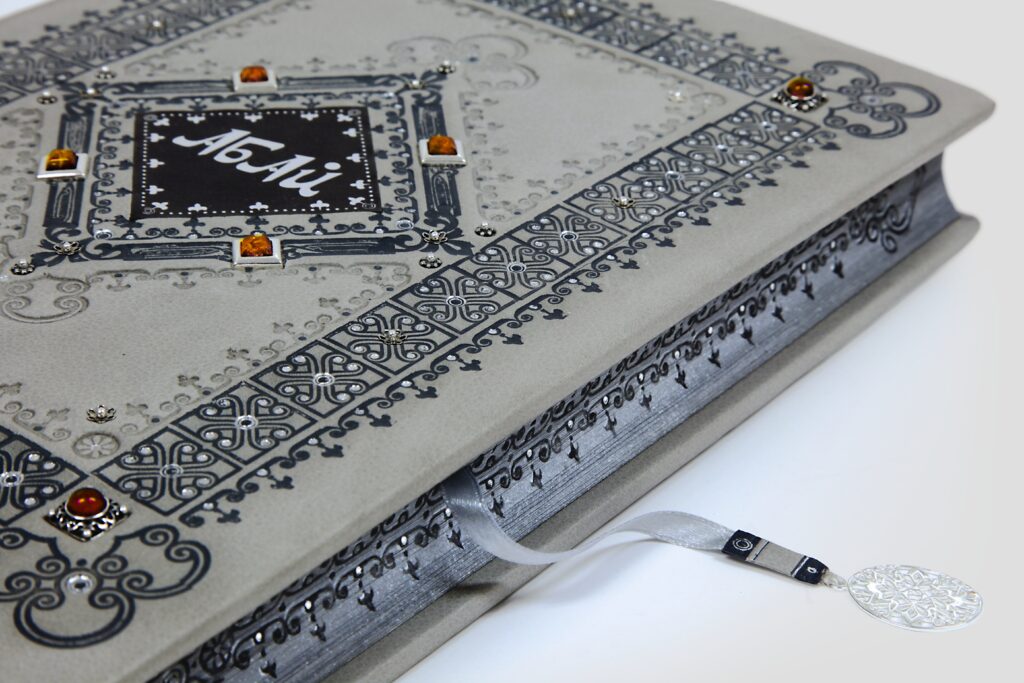
This collector’s edition presents one of the most important books in Kazakh culture in the Kazakh language itself. Abaj Kunanbajew is not merely a poet of national importance, but one of the defining makers of modern Kazakh literary language and moral thought. His work belongs to the sphere of cultural foundation.
The edition was designed in direct relation to Kazakh artistic tradition. Rich silvered borders and characteristic national ornament shape the decorative language of the book, while a restrained silver-grey palette is combined with deep blue or black leather. The result is ceremonial, but disciplined.
Printed on artistic papers with a parchment-like texture and supplemented by silvered tracing paper, the edition gives material dignity to a text of civilisational importance. It is a book conceived not only for readers, but for cultural memory itself.
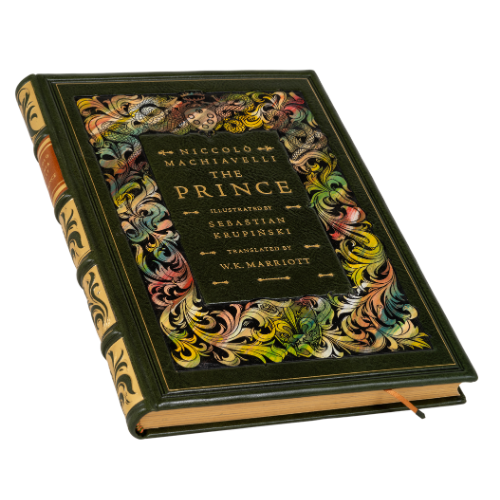
Machiavelli Niccolò — The Prince
Few texts in political literature have had an afterlife as powerful, disputed, and enduring as The Prince. Machiavelli’s book has long ceased to be only a Renaissance work; it has become a permanent point of reference in discussions of power, image, rule, prudence, fear, and calculation. Precisely for that reason, it deserves a form of greater seriousness than the merely functional edition.
This collector’s version approaches the work not as a slogan-producing classic, but as a text of lasting intellectual sharpness. Sebastian Krupiński’s illustrations contribute a visual atmosphere of control, ambiguity, and symbolic tension. The binding, in turn, adopts a language of measured authority: ornament restrained by structure, richness governed by clarity, and visual force without theatrical excess.
The edition recognises that The Prince is always read in the shadow of politics as performance. It therefore stages the text materially, but with discipline. The result is a volume whose form answers the central paradox of Machiavelli: that power is never only substance, and never only appearance, but always an art of relation between the two.
Mickiewicz Adam — Pan Tadeusz
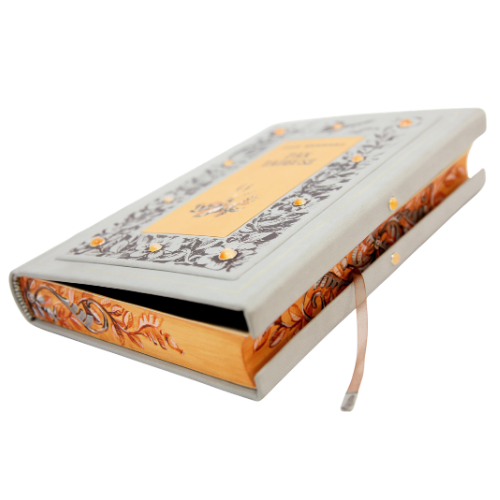
Pan Tadeusz stands as the last great epic poem of European literature and occupies in Polish culture a place comparable, in moral and symbolic weight, to Homer in the classical tradition. It is not merely a literary masterpiece, but a work in which memory, homeland, custom, exile, wit, and national imagination are held together within one sweeping form.
For this reason, the edition demanded a form of corresponding dignity. Printed on fine art paper and bound entirely by hand, it was conceived not as a simple English-language publication, but as a collector’s object capable of carrying Polish literature into an international context without diminishing its scale or gravity. Jerzy Kozimor’s illustrations lend the edition a distinct interpretative layer, while the bindings — in selected cases enriched with silver and gemstones — transform the volume into a material expression of continuity, ceremonial memory, and artistic presence.
Each element of the edition has been chosen with care: the structure of the leather, the rhythm of the decoration, the balance of the page, and the proportion of text to image. The result restores to Pan Tadeusz something of its monumental character — not through excess, but through a disciplined unity of literary meaning and crafted form.
Muhammad al-Ali — Treatise on the Wonders of Astronomy
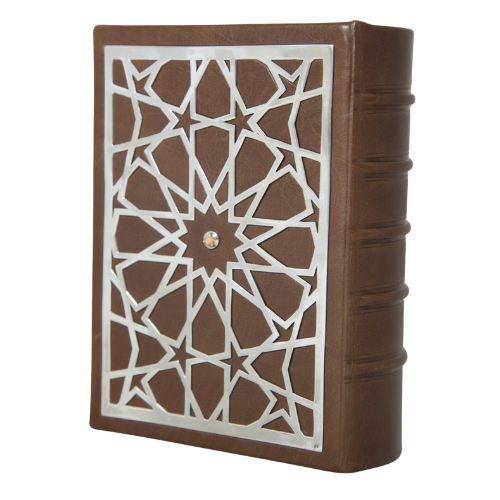
Muhammad al-Ali’s Treatise on the Wonders of Astronomy was written in 1434 as a work devoted to astronomy and geography. In spirit, it may be understood as a medieval encyclopaedia: a text in which scientific curiosity, cosmological imagination, and ordered knowledge are held within a single learned structure.
The original manuscript followed a long path through the hands of collectors before entering the National Library in Warsaw. It remains the only known copy of this work in the world. For that reason, the facsimile edition carries a significance beyond ordinary publication. It is not simply a reprint, but an act of preservation and renewed visibility — a way of allowing a singular work of Arabic intellectual heritage to re-enter the world of readers and collectors.
Issued in only twenty-five numbered copies, printed on artistic handmade paper, and bound by hand in leather, the edition is rare not only by limitation, but by historical circumstance. These copies are themselves unique in the world. They do not replace the manuscript; they prolong its afterlife. Their value lies not only in beauty or scarcity, but in their role as material continuations of a text otherwise inaccessible.
Ovidius Naso, Publius — De Medicamine Faciei Feminae
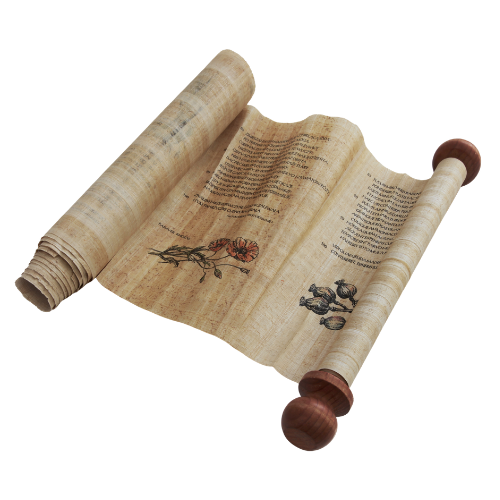
Ovid’s cosmetic poem survives only in fragmentary form, scarcely one hundred lines preserved by a medieval scribe. The problem was therefore not only how to publish the text, but how to give proper form to a work so brief. The answer was not reduction, but historical return.
Because the poem was written in the first year CE, the edition was conceived not as a codex but as an ancient scroll. Research into museum collections and antique descriptions — including Pliny the Elder — guided the reconstruction of a mode of bookmaking appropriate to antiquity. The result is a book shaped not by later habit, but by historical imagination.
The first thirty copies were printed on genuine Egyptian papyrus; the remainder on handmade paper. The form, illustration placement, script rhythm, and reading movement all respond to the logic of the ancient roll. This is one of the clearest examples in the programme of a fine press edition becoming a work of historical interpretation.
Pawlikowska-Jasnorzewska Maria — Epitaph for Hawthorn
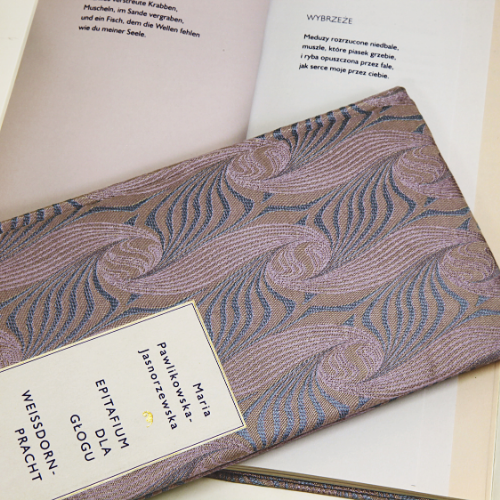
This edition gathers poems by Maria Pawlikowska-Jasnorzewska selected from those which Karl Dedecius considered most essential and characteristic of her work. It was conceived not merely as a container of poems, but as a lyrical object in itself.
Włodzimierz Kukliński’s graphics form a metaphorical companion to the poems, avoiding literal illustration and remaining in harmony with Pawlikowska’s delicacy, brevity, and emotional precision. The whole volume is maintained in a disciplined chromatic field of pearl and violet tones. Several kinds of paper are used, yet all remain within one atmosphere, corresponding to the specially woven silk jacquard binding.
The pages vary in width, longer leaves are folded, and the book carries a subtle cyclamen fragrance. These elements slow the act of reading. The volume asks not to be browsed, but unfolded and encountered gradually. In this sense, it becomes a poetic object not only by content, but by tempo.
Prévert Jacques — L’Orgue de Barbarie
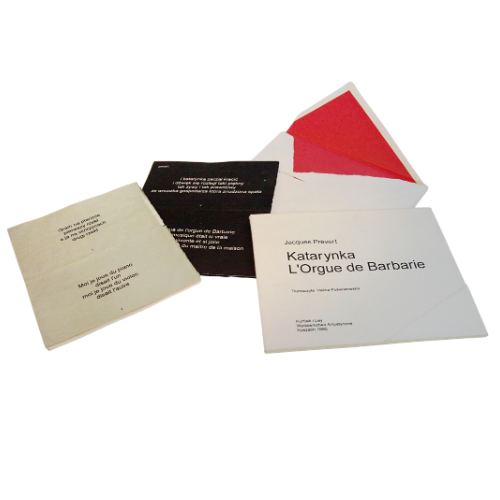
This bilingual edition of Prévert’s L’Orgue de Barbarie was conceived as a book-object rather than a conventional bound volume. The poem’s rondeau-like composition, its circular movement, irony, and recurring logic suggested a form that could be read without end: a joined accordion.
The cover takes the form of a handmade paper envelope, while the interior unfolds as one continuous sequence. The reader does not merely turn pages, but handles space. In this way, the book becomes a structural answer to the poem itself. Its slightly macabre, philosophical, and playful tone is not only described; it is enacted by the form.
The result is a volume in which material structure becomes interpretation. It does not illustrate Prévert’s poem from the outside. It continues it.
San Juan de la Cruz — The Poems of Saint John of the Cross
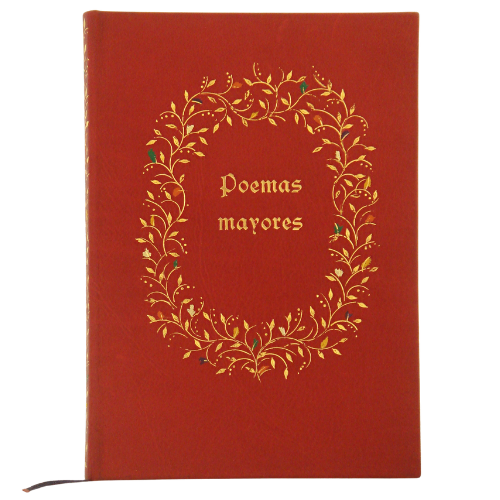
This edition was created for one of the highest achievements of mystical literature. Two of the three major poems contained in the volume were written in prison; the third, The Living Flame of Love, after escape. These circumstances are inseparable from the inward force of the work, which unites extremity of experience with extraordinary spiritual refinement.
Saint John of the Cross has often been described as the greatest mystic among poets and the greatest poet among mystics. His writings belong not only to the summit of Spanish literature, but to the culminating moments of mystical expression in world literature. The edition therefore required a form of exceptional dignity and restraint.
Issued in only thirty-eight numbered copies, with jewellery bindings and leather fine bindings alike, and enriched by hand-applied 23-carat gold tooling on both covers and pages, the book becomes a material act of reverence. It is not merely finely made; it is a volume shaped for works that belong to the highest registers of reading.
Shakespeare William — As You Like It
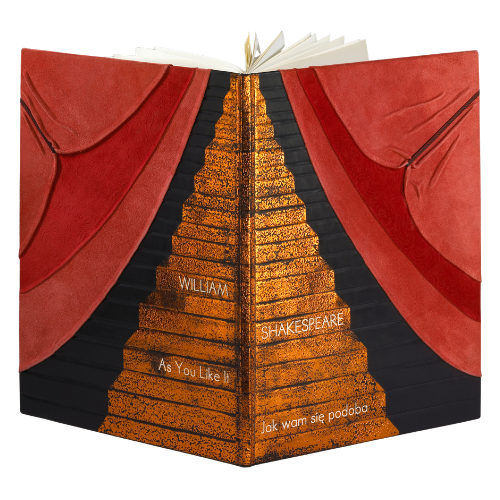
As You Like It is one of Shakespeare’s most intelligent and playful comedies: a work of mistaken identities, theatrical wit, role-playing, verbal grace, and carefully managed disorder. It required an edition capable of meeting comedy not with heaviness, but with precision.
Andrzej Czeczot’s linocuts provide exactly that response. Reduced, clear, and sharpened by wit, they understand the dramatic convention without burdening it. Their simplicity is not poverty but intelligence. Printed on handmade paper, they proved visually strong enough to demand a page architecture spacious enough to carry them. Wide margins, clear typography, and an airy field around the text allow both reading and viewing to occur without strain.
The bindings — in leather, half-leather, and in especially rare cases original parchment with 22-carat gold ornament — complete the edition’s dual character: light in movement, refined in structure. This is a Shakespeare edition shaped by proportion, timing, and elegance rather than by excess, and therefore wholly suited to the comedy it serves.
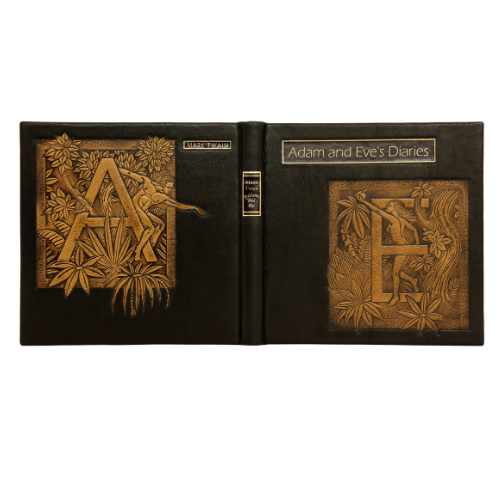
Twain Mark — Adam and Eve’s Diaries
Mark Twain’s Adam and Eve’s Diaries is among his most tender and perceptive meditations on love, difference, mutual fascination, and the first great emotional bond. Through the diary form, Twain transforms the biblical first pair into an occasion for wit, insight, and emotional intelligence.
The edition was conceived with corresponding originality. Some copies take the form of a frame-book — a legally protected concept in which the book may be displayed as an object on the wall and removed for reading by its owner. Others were issued in artistic hand-bound form. The project therefore moves between literature, collector’s object, and invention.
It is precisely this union of literary charm and structural originality that explains the edition’s exceptional reception. It has received multiple awards, but its true distinction lies in the fact that it gives Twain’s text a form equal to its emotional wit: intimate, memorable, and unlike anything ordinary gift culture would produce.
Twain Mark — Virtues and Other Vices
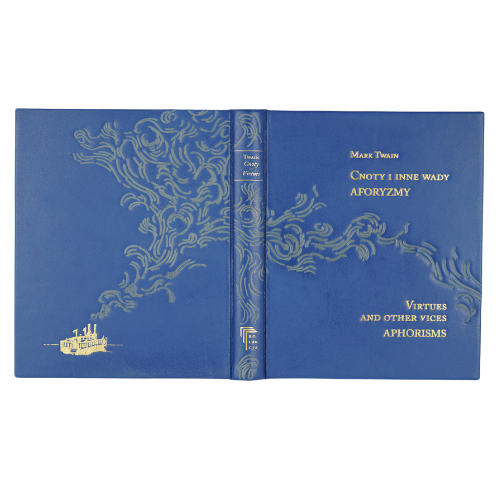
This edition of Twain’s aphorisms presents wit in concentrated form. English and Polish stand beside one another, allowing the precision, irony, and moral sharpness of the text to unfold bilingually and without dilution.
Krzysztof Urbanowicz’s illustrations build their own narrative gradually through the volume, moving from one image to layered combinations of several images. The effect is cumulative, as though visual thought were taking shape alongside the aphorisms. Materially, the edition also exists in two distinct characters: a cornflower-blue leather binding with gilded and blind embossing, and an indigo velvet version described as “vegan.”
At the end of the volume, a notebook has been included for the reader’s own notes, reflections, and perhaps further Twain aphorisms. This is a fine detail with large consequences: each copy may slowly become personal. The book therefore does not end with Twain, but invites continuation by its owner.
Wyspiański Stanisław — The Wedding
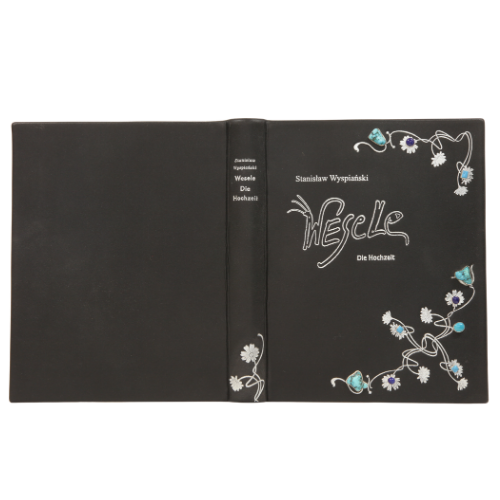
At first glance, Wyspiański’s The Wedding may appear too deeply rooted in Polish history, symbolism, and collective imagination to travel well beyond its native cultural sphere. Yet beneath that specificity lies one of the great strengths of the drama: its metaphysical intensity. It is not only a national drama, but a haunted and visionary work about ritual, paralysis, longing, and collective self-recognition.
The German-language staging by Andrzej Wajda, presented in Salzburg in 1992, confirmed that this power could indeed reach foreign audiences. That experience helped inspire the edition of the work in broader linguistic form. The book was therefore conceived not only as a publication, but as a deeper act of transmission: an attempt to carry the atmosphere of the drama beyond immediate familiarity with Polish tradition.
Issued in Polish, German, and English versions, and shaped typographically by Iga Bielejec, the edition seeks clarity without simplification. It gives Wyspiański’s drama a form through which its visionary and symbolic power may become legible, even where the entire cultural context is not automatically shared.
Strictly Limited, Individually Documented
All editions are issued in strictly limited print runs. Each copy is individually hand-numbered and formally documented in our publishing archive.
For the collector, this ensures possession of a work whose form and concept will not be repeated. Our books are created as enduring artistic objects — conceived as elements of cultural heritage intended for generations.
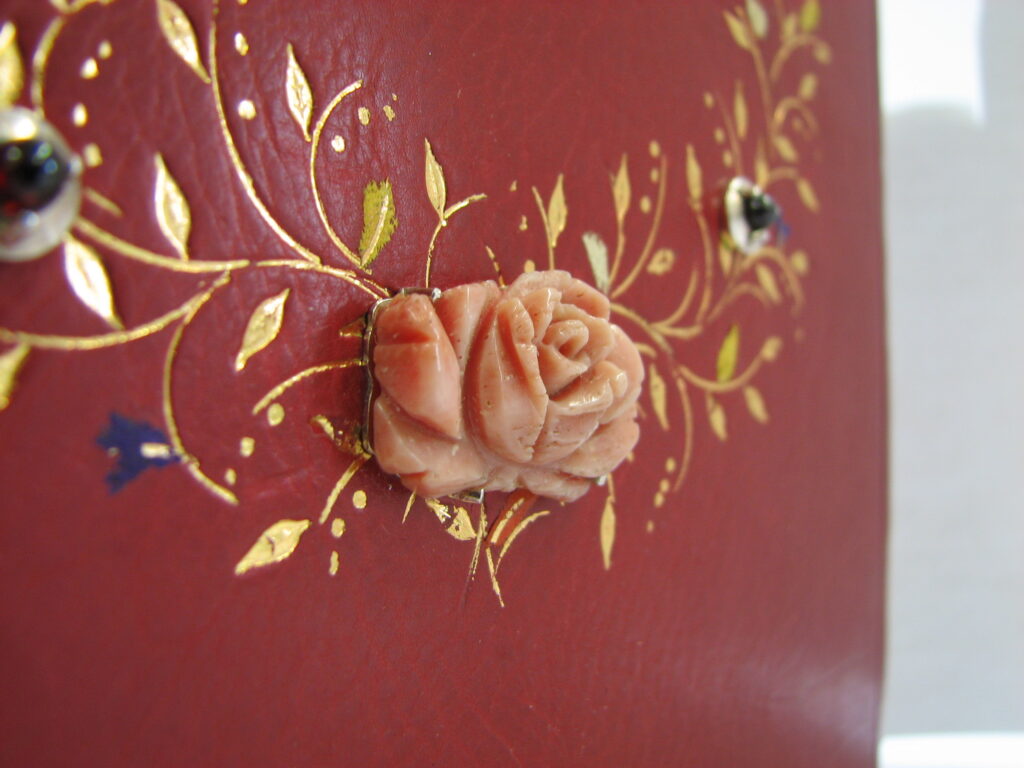
A broader illustrated selection may be provided by private correspondence.
For those wishing to review additional titles, illustrations, and binding variations, we will be pleased to provide a dedicated PDF presentation.